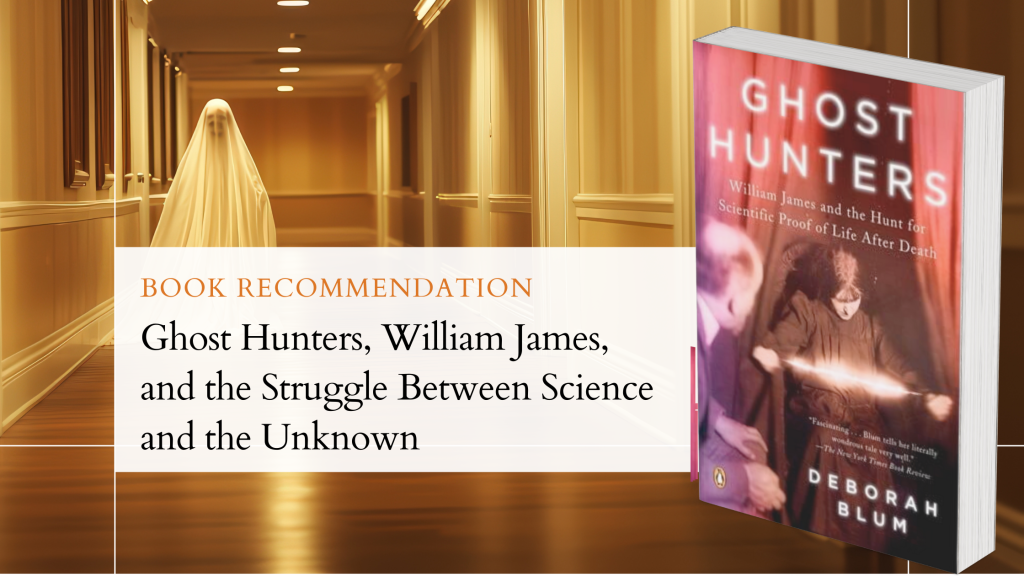
Every once in a while, I stumble across a book that doesn’t just inform—it resonates. Deborah Blum’s Ghost Hunters: William James and the Search for Scientific Proof of Life After Death is one of those books. On the surface, it’s a history of late-19th and early-20th century spiritualism, with séances, table-rappings, and ectoplasm. But Blum’s account goes deeper. She focuses on William James—the philosopher, psychologist, and co-founder of the Society for Psychical Research—and his colleagues, who stood at a crossroads between faith, science, and mystery.
What makes the book so compelling is its honesty. James and his peers were not gullible seekers blindly chasing spirits in darkened parlors. They were scientists. They investigated mediums. They exposed frauds. But at the same time, they refused to slam the door on the possibility of something beyond the material world. In fact, their determination to use the scientific method to test the unknown stands in stark contrast to much of what passes for “science” today—where consensus often substitutes for curiosity, and anything that falls outside the accepted framework is dismissed as superstition.
The parallel between their time and ours is hard to ignore. Then, as now, there was a cultural divide: reductive materialism on one side, and the individual’s timeless search for purpose on the other. The “consensus” camp insisted on a closed system, one that explained everything through physical processes and nothing else. But James believed (and I agree) that the human spirit demands more. If we deny even the possibility of God—or of something beyond the veil—we fall into nihilism. And nihilism is not a philosophy people can live on.
This is why stories of myth and magic are so persistent in every culture. They’re not “improbable” escapes—they’re necessary explorations. They remind us that the world is not exhausted by what we can measure. They open up spaces for wonder, danger, and discovery. They allow us to imagine that our place in the universe might mean more than just a flicker of neurons firing before the lights go out.
Reading Ghost Hunters also reminded me of the themes I explore in The Angelus Key. In my novel, seekers wrestle with hidden knowledge, dangerous powers, and the tension between technology and mystery. Like William James, my characters are caught between skepticism and yearning, between the safety of what is “known” and the perilous hope that there’s more to reality than the textbooks admit.
If you’re interested in history, philosophy, or simply the ongoing human quest for meaning, Deborah Blum’s book is a rewarding read. It’s also a sobering reminder that the struggle between materialist reductionism and the hunger for transcendence is not new—it’s been with us for centuries, and it’s not going away.
Because at the end of the day, science can tell us a great deal about how the world works. But it cannot tell us why we’re here—or whether, when the curtain falls, the story really ends.