Those of you who have read The Angelus Key know how much I enjoy a good footnote. Unfortunately, I needed to make room on some pages for the primary narrative, and, accordingly, I was forced by my editor to “kill my darlings.” (But only some, not all.) However, this footnote, although not in the final version of the novel, I include here in its full glory.
The context: As the Archaeomancer for the Order of Wisdom of Light Seekers, Boina Talleruud specializes in artifacts of the magickal kind. But she employes her skills not just in the sacred chamber of the Fortune Athaenium for the Owls: she also has a day job at the British Museum, doing much the same thing but with no fanfare. Hers is a hush-hush role at the ol’ BM. They wouldn’t enjoy having their sterling reputation tarnished with superstitious nonsense, and yet, Boina goes to work, day in and day out, assessing acquisitions for magickal spells or spiritual attachments.
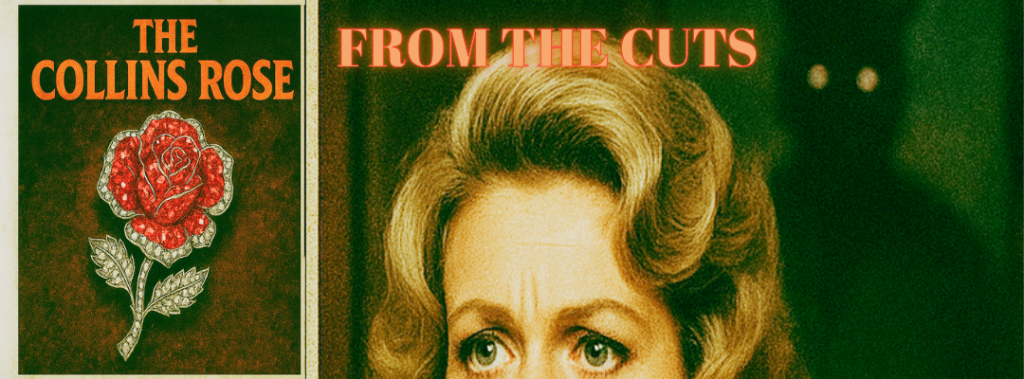
The Collins Rose: A Brooch with Ambitions
Some objects are beautiful; some are useful; a select, troublesome few are hungry. The Collins Rose—diamond and ruby, shaped like a bloom with too many secrets—managed all three. Though the piece is modern (you won’t find it on a Tudor bodice), it ran a speed-trial through owners as if auditioning them.

Movie Poster: The Collins Rose, 1972. Courtesy of Caliban Pictures.
Its first wearer was a British leading lady of the stage-and-screen variety. We’ll call her J.C. to protect the allegedly innocent and to spare me an email from her agent. In the early 1970s, when horror films were (once again) paying the rent, she accepted a role that took the occult a bit more seriously than the craft services table did. The production demanded “immersive ambiance,” which here means: they performed ceremonial black magick together because method acting hadn’t suffered enough.
J.C. wore the Collins Rose during the ritual. She didn’t believe in magick—she believed in lighting, lenses, and leaving the wrap party before the cocaine showed up. The demon Moromothe, regrettably, did believe in magick, and more to the point, believed in causing suffering.
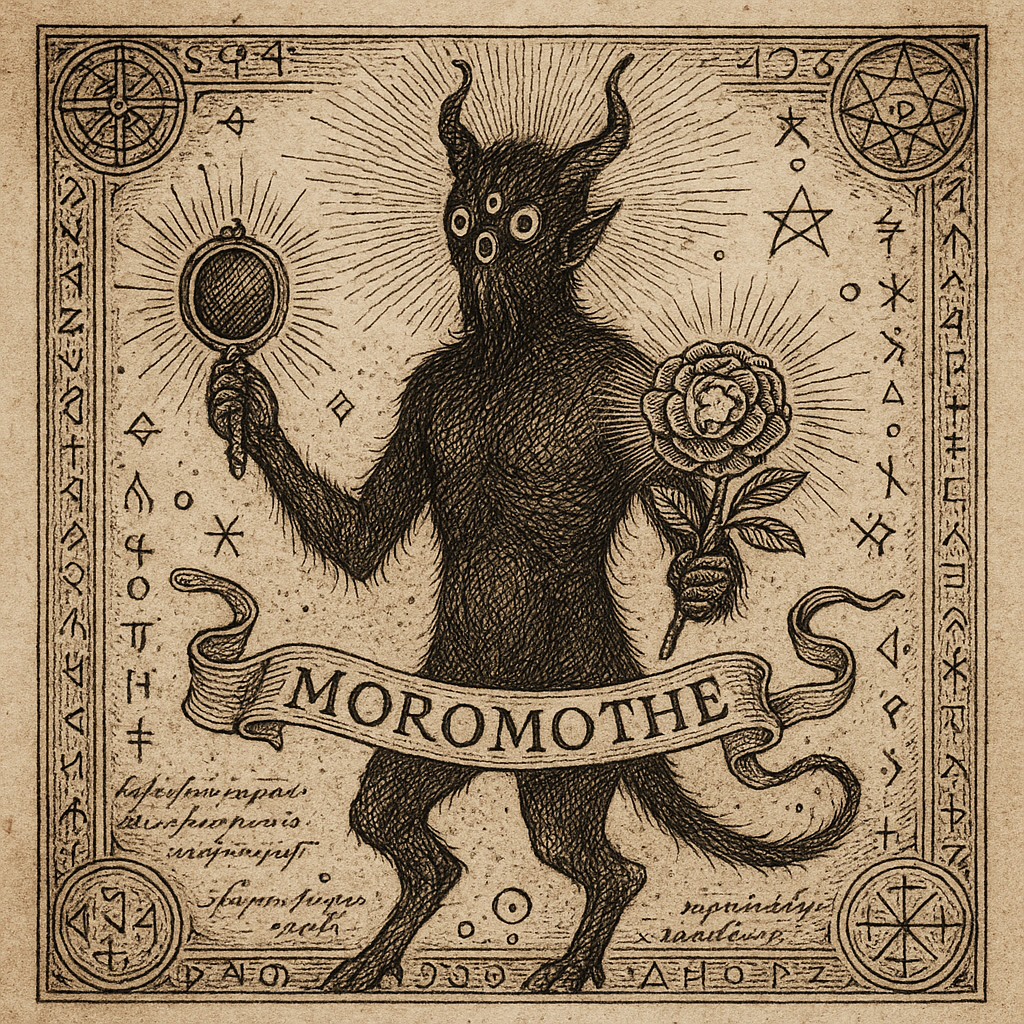
The Demon Moromothe, Patron of Glare and Self-Regard
Think less “ancient devourer” and more “cosmic theater kid who never got a solo.” Moromothe attaches to shiny things the way a toddler attaches to a xylophone: enthusiastically, and at the worst possible time.
In every scene in which J.C. donned the Rose, her camera crew complained of lens flares that ruined the exposure so much that they darkened nearly everyone of her shots, making her appear shadowy throughout the movie, an effect she did not endorse.
Then came the headaches. When she wore the Rose, migraines erupted as if on cue. There is no denying that J.C. is a consummate performer, and she worked through the pain. That’s why you may notice her almost constant grimace in the movie, if you can see her face at all in the dark.
To this day, no one can explain the shadow that appeared in the scene shot within the Grand Hall of Freemasonry, Portsmouth Liberty Lodge. The shadow bore a distinct shape, that of a demon; however, this was not intended, nor was it germane to the scene, which was about finding the heroine’s missing uncle.
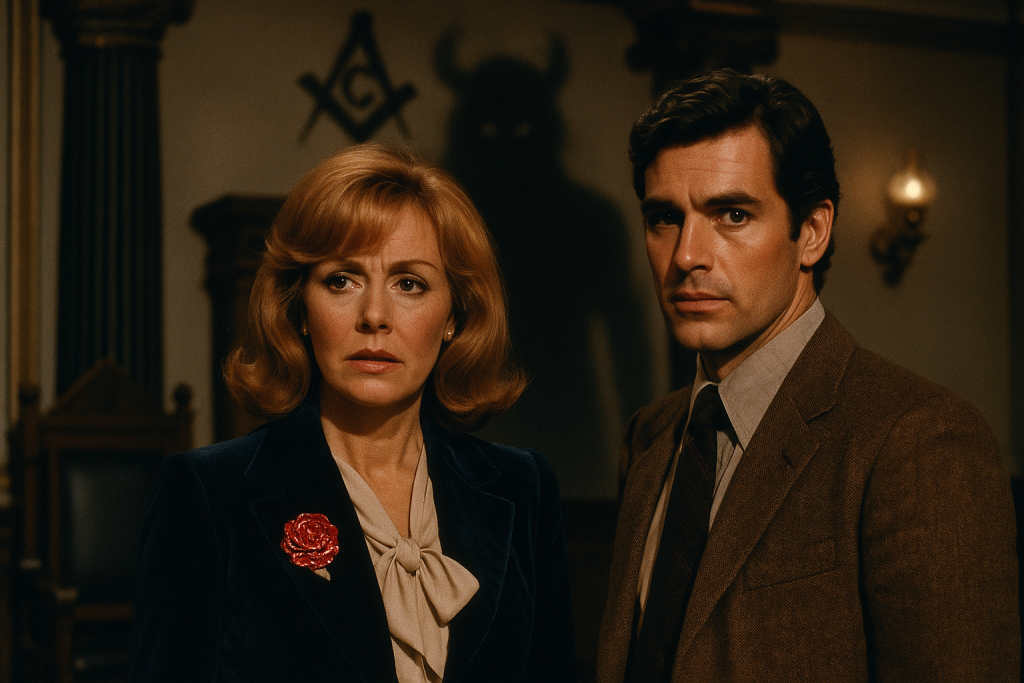
Clip from The Collins Rose, 1972. Courtesy of Caliban Pictures.
Her actions, on and off, camera became erratic. She became ravenous for Marmite, a vegetable spread that she had previously described as “jam for the witless.” She climbed stage rigging to eat Marmite sandwiches, claiming that the crew was plotting against her. To be fair, this became true toward the end of filming, and it wasn’t just the crew. The director, the producer, the caterers: they all were plotting against J.C.

“You Don’t Have to Like It” ad for Marmite, 1984.
Finally, in desperation, J.C. hired a medium to de-curse her. The medium, whose fee I assume included hazard pay, quickly determined that misfortune had befallen J.C. because of the Collins Rose.
Subsequent owners fared no better—boils here, blights there, reputations wilting like daisies in the grip of late-August heat. Finally the brooch went into a display case at a Hollywood memorabilia museum. It burned down almost immediately. From there, it made the rounds from the insurance company, into a private estate, which quickly led to a private sale and then a quiet donation to the British Museum.
Enter Boina Talleruud, Archaeomancer for the Owls.
Archaeomancy 101 (or: how to evict a demon without losing your deposit)
Boina Talleruud, whose specialty is the archaeology of malefice (call it archaeomancy if you like your Latin served al dente), confirmed that the Collins Rose had collected a significant residue of malign intent. As for Moromothe, he’d nested neatly in the brooch’s setting like a smug little barnacle.
Boina’s Magick Remediation Methodology
- Isolation: Artifact placed under a warded glass bell. (Yes, glass can be warded. No, IKEA does not sell the good ones.)
- Naming: The entity’s True Name spoken once, precisely. (Think password, but the ancient, screaming kind.)
- Displacement: A ball of wax wrapped in aluminum foil—the occult’s least glamorous hazmat suit—offered as a new address.
- Combustion: Foil bundle into the fire. Exit Moromothe.
Where is Moromothe now?
At large. Drawn to spotlights, reflective surfaces, and any conversation that begins with “I’m not like other demons.” If your jewelry box smells like soup that made a bad decision, you know who to call. (Not me. I’ll call Boina. She’ll call the bell jar.)
Why this didn’t make the final cut
Pacing. Much as I love a jewel with a personality disorder, Boina Talleruud needed to enter the scene like a scalpel, not a scrapbook. But stories have residuum, and this one glowed in the margins. Consider it a caution: rituals are not props, and demons—especially the needy ones—are terrible publicists.