Why I Wrote Snowfall on Miracles & Ghosts
For as long as I can remember, I’ve loved Christmas.
Not the shopping-mall version with frantic parking lots and canned music on repeat, but the quieter Christmas that happens in the margins: late walks in the cold, the way light spills from a window onto the snow, the odd mixture of memory and expectation that hangs in the air on Christmas Eve. It has always felt like the one night of the year when anything could happen.
When I finished writing The Angelus Key, I knew I wanted to come back to that world in a way that felt like a gift. Not a full sequel, not another apocalyptic ritual, but a smaller, more intimate story that could stand on its own. A story that would let me spend time again with Dr. Stephen Dunlop and Sofia Ramirez, and, perhaps most surprisingly, with Veuxloure, everyone’s favorite untrustworthy curator.
That became Snowfall on Miracles & Ghosts: Christmas at Maison d’Aurum.
In the main novel, the stakes are high: lost manuscripts, dangerous workings, people willing to bend the spiritual world toward their own ends. There are angels and charters and very real consequences when those things go wrong. But in this Christmas novella, I wanted to step away from overt occult workings and see what happened if I stripped the magick down to something simpler: people, memory, and the choices we make when no one is looking.
There are no rituals in this story. No summoning circles, no voices from beyond the veil. Instead, the magick lies in three small objects and the human histories attached to them:
- A brass star that once marked a door of refuge in a besieged port
- A nurse’s watch that kept time through a winter of illness and fear
- A hand-carved Nativity whose empty cradle is filled, secretly, with the names of the disappeared.
On the surface, Snowfall on Miracles and Ghosts is simple: Dunlop and Sofia are stranded in Geneva after a contentious restitution mission in Paris. They’re not speaking. Their flight is canceled. They have nowhere to be on Christmas Eve. Veuxloure, of all people, invites them to an after-hours viewing at his beloved Maison d’Aurum. Over the course of the night, as he tells the stories of those three objects, Dunlop and Sofia are drawn—reluctantly—out of their argument and back toward each other.
Underneath, though, the story is doing something that feels very close to Christmas for me. It’s about how we carry the past we didn’t choose, how we try (and fail, and try again) to act justly in the present, and how the future is shaped by acts of mercy and courage.
Veuxloure was especially fun to revisit. In The Angelus Key he is dangerous, charming, and morally flexible—exactly the kind of man you should never trust with a cursed object. In this story, he is still all of those things, but we also see what happens when he is alone in his museum on Christmas Eve, rearranging his ghosts. He is, in many ways, the last person you would choose as a companion for the holiday. Which makes it all the more important that Dunlop and Sofia choose him.
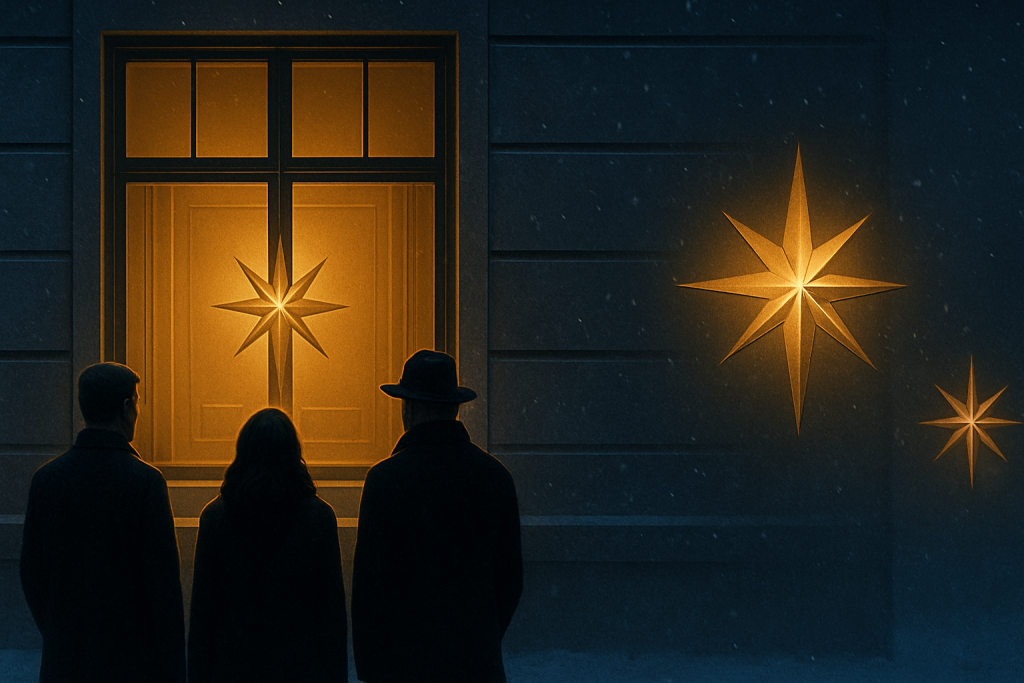
If you’ve read The Angelus Key, you will find familiar tones here: art and archives, questions of restitution, a slightly haunted atmosphere, a literary style that lingers on details. But if you have not read the novel, you can start with this novella and be perfectly at home. You don’t need to know any lore. You don’t need a guide to angelic alphabets. You only need to know what it feels like to stand outside in the snow, looking in at a lit window, and wonder whether you should go back inside.
This is a quiet book. It’s meant to be read in one or two sittings—maybe late at night with a blanket and something warm to drink. It’s for readers who enjoy a little mystery, a little art history, and a lot of heart; for people who like their Christmas stories with more candlelight than tinsel.
There is no overt occult magick in Christmas at Maison d’Aurum. There is, I hope, the gentler magick that comes when people decide not to leave each other alone.

If the main novel is about what happens when the wrong people get hold of sacred things, this little story is about what happens when flawed people make room for one another on a cold night and share what they have: a star, a watch, an empty cradle, some panettone, and a few hard-won stories.
If you love Christmas, and you love the tone and texture of The Angelus Key, I wrote this one for you.
MORE FROM THE ARCHIVES
- Christmas with the ANGELUS KEY

- Dion Fortune’s Psychic Self-Defense: A Guide to Psychic Attack, Diagnosis, and Protection

- Wearing the Antlers: How Yellowjackets Builds and Breaks Folk Horror

- Dion Fortune & The Sea Priestess

- From the Cuts: The Ogre, the Monk, and the Girl Who Wanted More (Eiger · Mönch · Jungfrau)